Neurofeedback for Sports Performance: What the Science Says
Can you train your brain to perform better under pressure? Emerging neuroscience says yes — and the technology behind it is already available at Mindstate Psychology in South Perth. This article explores what neurofeedback is, how it applies to athletic performance, and what recent research tells us about its real-world effectiveness.
The Mental Edge in Elite Sport
Every athlete knows that physical conditioning only goes so far. At the highest levels of competition, the difference between winning and losing often comes down to mental performance — the ability to stay focused, regulate anxiety, and execute fine motor skills under extreme pressure.
For decades, sports psychologists have helped athletes develop these skills through visualisation, mindfulness, and psychological skills training. Now, a neuroscience-based approach called neurofeedback is adding a new dimension: the ability to directly observe and train the brain activity that underlies optimal performance.
Neurofeedback provides athletes with real-time feedback on their brainwave patterns, and, through practice, helps them produce the neural states associated with focused, efficient performance. Think of it as a training environment for the brain itself.
What Is Neurofeedback?
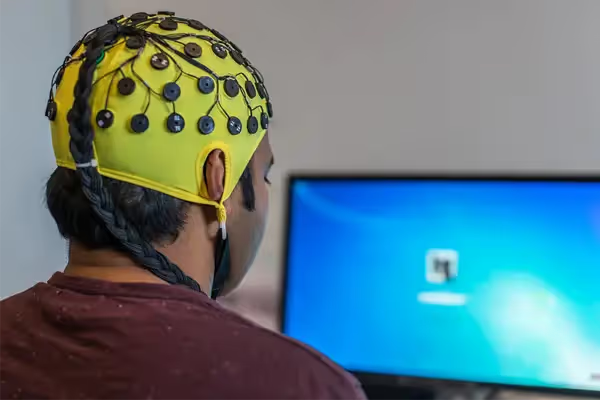
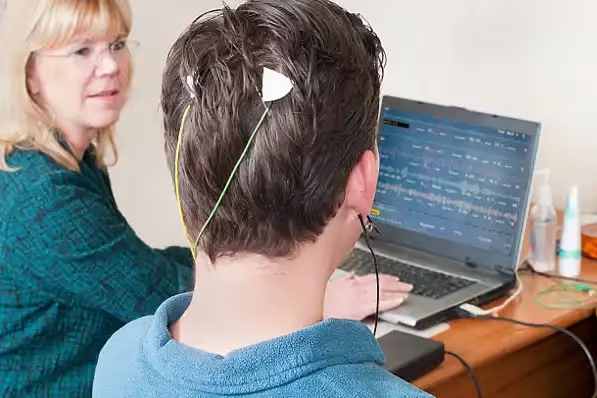
Neurofeedback — also called EEG biofeedback — is a non-invasive technique that measures the brain's electrical activity using sensors placed on the scalp, then feeds that information back to the individual as an audio or visual signal. Through repeated sessions, the person learns to shift their brainwave patterns in a desired direction.
At Mindstate Psychology, our neurofeedback services are guided by quantitative EEG (QEEG) assessment, a detailed brain-mapping process that identifies an individual's unique neural patterns before training begins. This means sessions are tailored to each person's brain, rather than following a generic protocol.
QEEG-guided neurofeedback is considered best practice in the field. It allows our clinicians to identify exactly where in the brain to target training and which frequency bands are relevant for that individual's goals.
What Does the Research Show for Sports Performance?
The evidence base for neurofeedback in sport has grown substantially over the past decade. Here is a summary of what the current research tells us.
A Growing Body of Evidence
A recent meta-analysis examining21 controlled studies found moderate evidence that EEG neurofeedback produces meaningful improvements in sports motor performance. The sports studied included golf, putting, rifle and pistol shooting, archery, balance, cycling endurance, and dance. Crucially, studies with stronger methodological designs showed larger effects — suggesting that well-implemented neurofeedback produces real, measurable gains.
A separate review of studies published between 2016 and 2023 found that neurofeedback training produced significant improvements in athletes' cognitive and sports performance across multiple studies, with notable benefits in attention, concentration, reaction time, stress management, and emotional regulation.
The Quiet Brain Advantage
A key theoretical framework running through the sports neuroscience literature is the psychomotor efficiency hypothesis. This proposes that expert performers don't activate more of the brain than novices — they activate less. Elite athletes show more selective, efficient neural activity during skilled movement, suppressing irrelevant processing while amplifying task-relevant signals.
In practical terms: the expert brain has learned to get out of its own way. Less conscious analysis, more automatic, precise execution. Neurofeedback offers a structured method for training athletes toward exactly this kind of neural efficiency.
This has been demonstrated clearly in precision sports. Research comparing the brain activity of higher and lower-performing sharpshooters found that superior shooters showed greater sensorimotor rhythm (SMR) activity, a brainwave pattern linked to motor stillness and readiness, and reduced communication between motor-planning areas and regions associated with verbal-analytical thinking. The better the shooter, the quieter the analytical mind.
Neurofeedback Can Train These States
Critically, these neural states are not just measurable — they are trainable. A six-week neurofeedback intervention with experienced air pistol shooters found that athletes trained to increase alpha activity over the left temporal cortex showed significantly greater improvements in shooting accuracy than a control group. The more time athletes spent sustaining the target neural state during sessions, the greater their performance gains — a dose-response relationship that points to a genuine causal link between neural self-regulation and performance outcomes.
The benefits also extended beyond the targeted brain region, with elevated alpha activity appearing across both temporal cortices — suggesting that targeted neurofeedback can influence broader neural networks involved in attention and motor planning.
How Neurofeedback for Sports Performance Works
For performance applications, neurofeedback typically follows a structured process:
- QEEG Brain Map: An initial quantitative EEG assessment maps the athlete's brain activity across multiple frequency bands and regions, identifying patterns that may be limiting performance or diverging from expert norms.
- Protocol Design: Based on the QEEG findings, a personalised training protocol is designed — specifying which brain regions to target and which frequency bands to train up or down.
- Training Sessions: Over a series of sessions, the athlete receives real-time feedback about their brain activity while focusing on a target or task. With practice, the brain learns to produce the desired neural patterns more consistently.
- Progress Review: Periodic reassessment tracks changes in brain activity and correlates them with performance outcomes, allowing the protocol to be refined over time.
Most neurofeedback research in sports has used between 10 and 20 sessions. Some studies have produced measurable effects with as few as 6 sessions, though more sustained protocols tend to yield more durable changes.
Key Brainwave Targets in Sports Neurofeedback
Different frequency bands are associated with different cognitive and motor states. The most commonly targeted in sports contexts include:
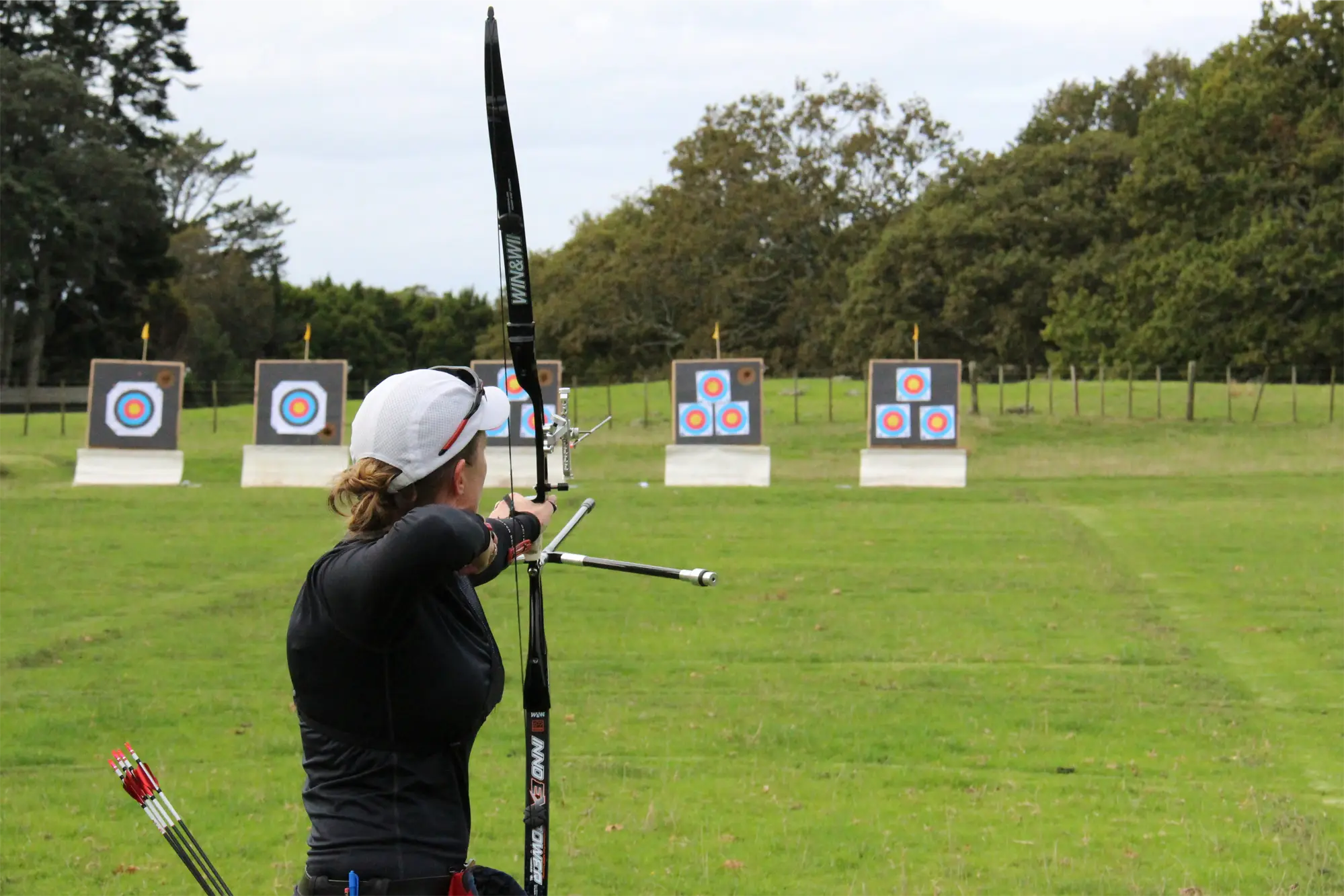
- Sensorimotor Rhythm (SMR, 12–15 Hz): Recorded over the motor cortex. Associated with motor readiness, stillness, and fine motor control. Uptraining SMR while inhibiting theta is the most common protocol in precision sports such as shooting, golf, and archery.
- Alpha (8–13 Hz): Associated with relaxed attention. In the left temporal region, higher alpha activity is linked to reduced verbal-analytical interference — the neural hallmark of automatic, expert motor execution.
- Theta (4–7.5 Hz): Excessive theta is associated with mind-wandering and reduced sustained attention. Down training theta is commonly combined with SMR uptraining to improve focus and consistency.
- Beta (15–30 Hz): Associated with active cognitive engagement and alertness. Relevant in sports that demand fast decision-making and sustained vigilance under pressure.
What Can Neurofeedback Offer Athletes?
Based on the current research, neurofeedback for sports performance may support:
- Improved focus and sustained attention during competition
- Reduced performance anxiety and stress reactivity
- Greater consistency in fine motor execution
- Faster recovery of optimal mental states after errors
- Better sleep quality, which directly supports physical recovery and cognitive performance
- Enhanced emotional regulation under pressure
It is worth noting that neurofeedback is not a quick fix or a replacement for physical training and psychological skills work. It is best understood as a complementary tool, one that can help athletes access and consolidate optimal mental states more reliably, and that works synergistically with other performance support approaches.
Beyond Sport: Performance Under Pressure
The principles underlying sports neurofeedback apply equally to any profession that demands sustained precision and composure under pressure. Surgeons, pilots, law enforcement officers, musicians, and high-stakes business professionals all operate in environments where the ability to quiet analytical interference and execute trained skills automatically can be the difference between success and failure.
If you are seeking to perform at your best in any high-demand context, not just sport, neurofeedback may be worth exploring.
Frequently Asked Questions
How many neurofeedback sessions do athletes typically need?
Most research protocols use between 10 and 20 sessions. Performance benefits have been reported with as few as 6 sessions, but more sustained training tends to produce more durable changes. At Mindstate Psychology, the number of sessions is guided by your initial QEEG assessment and ongoing progress reviews, but we generally aim for a minimum of 20-40 sessions for maximum benifit and sustained growth.
Is neurofeedback suitable for all sports?
Neurofeedback has been studied most extensively in precision sports — shooting, archery, golf, and similar activities — where the link between neural states and performance is most direct. However, evidence also supports its use in team sports, endurance sports, and any athletic context where focus, anxiety management, and motor consistency are important.
Can neurofeedback replace sports psychology or mental skills training?
No — and it works best when used alongside traditional sports psychology approaches. Neurofeedback gives direct access to the neural states that underpin performance, but psychological skills training (visualisation, self-talk, pre-performance routines) builds the mental strategies that help you apply those states in competition. The two approaches are complementary.
Does Mindstate Psychology offer neurofeedback for athletes specifically?
Our neurofeedback services are guided by QEEG brain mapping and are tailored to each individual's goals. While our services are most commonly used in clinical contexts, performance enhancement is an application we support. If you are an athlete or performer interested in brain-based performance training, we encourage you to get in touch to discuss whether neurofeedback is appropriate for your situation.
Is QEEG assessment necessary before starting neurofeedback?
At Mindstate Psychology, yes. We believe QEEG-guided neurofeedback is the gold standard — it allows us to design a protocol based on your individual brain activity rather than a generic approach. This is particularly important for performance applications, where the training target needs to be precisely calibrated to your neurophysiological profile.
Neurofeedback at Mindstate Psychology, Perth
Mindstate Psychology is one of Perth's most experienced neurofeedback providers. Dr Phil Watts has been involved in neurofeedback since 2012, holds dual BCIA and QEEG certification, and has trained with specialists in both the United States and Russia. Our South Perth clinic offers QEEG assessment and neurofeedback training using professional-grade EEGer systems.
If you are an athlete, performer, or professional looking to explore neurofeedback for performance enhancement, contact our team to find out more, or visit our neurofeedback services page for information on assessments and fees.
.avif)

.avif)



.avif)
.avif)


.avif)