If your child has been referred for a cognitive assessment, chances are you have come across the term WISC-V and wondered what it actually means. It can feel daunting when a psychologist recommends an assessment using an instrument you have never heard of, especially when your child's schooling or wellbeing is at stake.
The good news is that the WISC-V is a well-established, carefully designed tool that gives clinicians and parents a clear picture of how a child thinks and processes information. This guide explains what the WISC-V is, what it measures, what to expect on the day, and how results are used to support your child's learning journey.
What Is the WISC-V?
The WISC-V (Wechsler Intelligence Scale for Children, Fifth Edition) is an individually administered cognitive assessment designed for children aged 6 years to 16 years and 11 months. The assessment has been standardised against children In Australia and New Zealand, which means your child's results are compared against children of the same age in Australia and New Zealand, not the United States.
It is the most widely used cognitive assessment tool for school-age children in Australia, with decades of research supporting its reliability and validity. The WISC-V gives clinicians detailed information that goes well beyond a single IQ score.
What Does the WISC-V Measure?
The WISC-V assesses five distinct areas of cognitive ability, each reported as a separate Index Score, as well as an overall Full Scale IQ. Understanding these five areas helps make sense of your child's cognitive profile.
Verbal Comprehension Index
This measures a child's ability to understand and use language, draw on vocabulary, and reason through verbal problems. It reflects how well a child learns from verbal instruction and communicates their knowledge. Children with strong scores here often excel in English, humanities, and verbal reasoning tasks.
Visual Spatial Index
This assesses the ability to evaluate visual details and understand spatial relationships, for example mentally rotating shapes or constructing patterns from blocks. Strong visual-spatial skills are often associated with strengths in mathematics, design, and the sciences.
Fluid Reasoning Index
This measures the ability to detect underlying conceptual relationships and think logically, even with novel problems that do not rely on previously learned information. It reflects problem-solving and abstract thinking, the kind of cognitive flexibility that helps children adapt to new learning challenges.
Working Memory Index
Working memory is the brain's mental workspace, the ability to hold and manipulate information in mind over short periods. It plays a critical role in reading, mathematics, and following multi-step instructions. When working memory is weaker than other cognitive areas, it can explain why a child struggles to keep up in class despite understanding material when it is explained one-to-one.
Processing Speed Index
This measures how quickly and accurately a child can process simple visual information. Processing speed affects how efficiently a child works in timed environments. A child with a slower processing speed may know their material thoroughly but struggle to demonstrate that knowledge within standard time limits, which is a significant disadvantage in conventional classroom settings.
Together, these five indexes produce a Full Scale IQ, which summarises overall cognitive ability. However, the profile across the five indexes is often more clinically useful than the FSIQ alone. A child may have significantly different strengths and weaknesses across these areas that a single number would mask.
What Happens During a WISC-V Assessment?
The WISC-V is administered one-on-one by an experienced psychologist in a quiet, distraction-free environment. The assessment typically takes between 90 minutes and two hours, depending on the child and the purpose of the assessment.
Your child will complete a series of tasks, some verbal, some visual, and some hands-on, that feel more like puzzles or games than a traditional test. There is no reading or writing required for most components, which means the assessment is not confounded by literacy skills in the same way a classroom test would be.
Children are encouraged to do their best, and the psychologist works to ensure the environment feels comfortable and low-pressure. If your child becomes tired or distressed, the assessment can be paused or split across multiple sessions.
After the assessment, the psychologist scores and interprets the results and prepares a comprehensive written report. Depending on the purpose of the assessment, additional testing may be required. ADHD assessments and educational assessments for specific learning disorders often involve additional tests. The psychologist should provide a copy of the report as part of a feedback session between the parents, and sometimes the child, if appropriate. They should walk through the findings and recommendations in plain language.
Why Is the WISC-V Requested?
Psychologists and paediatricians commonly refer children for a WISC-V assessment for a range of reasons, including concerns about learning difficulties or unexplained academic struggles that do not seem consistent with the child's apparent ability, suspected intellectual disability or giftedness where placement decisions need an evidence base, as part of a broader Specific Learning Disorder assessment, for ADHD evaluations where processing speed and working memory provide important diagnostic information, to support applications for educational accommodations or NDIS access, and to provide baseline data before a child starts a new school or intervention.
How Are WISC-V Results Used?
WISC-V results inform a wide range of decisions and interventions. They are used to develop Individual Education Plans in collaboration with schools, to identify the cognitive underpinnings of academic difficulties, to guide targeted strategies for parents and teachers, to support applications for exam adjustments or extended time, and to provide baseline data for monitoring cognitive development over time.
What Do WISC-V Scores Mean?
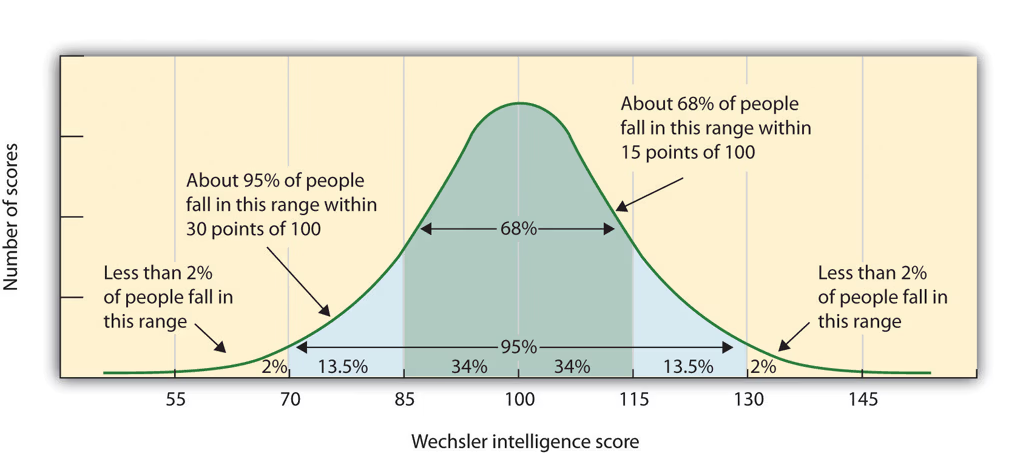
WISC-V scores are standardised so that the average score is 100, with a standard deviation of 15. Most children, approximately 68 per cent, score between 85 and 115. Scores are reported in descriptive ranges such as Average, High Average, Superior, or Below Average, which helps contextualise results without reducing a child's profile to a single number.
A score in the Average range does not mean a child has no difficulties. A profile showing significant variability between index scores, for example, a child with Superior verbal comprehension but Well Below Average processing speed, can still explain substantial day-to-day challenges and guide meaningful, targeted support.
How Long Until Results Are Ready?
The timeframe from assessment to report delivery is typically two to four weeks, depending on the complexity of the findings. The written report includes background information, all test results with interpretation, and specific, actionable recommendations. With your permission, the report can be shared with your child's school, paediatrician, or other treating professionals to support a coordinated approach.
Book a WISC-V Assessment at Mindstate Psychology
At Mindstate Psychology, our experienced psychologists conduct WISC-V assessments across our Perth locations. Whether you have been referred by a school or paediatrician, or you are seeking clarity about your child's learning journey, we are here to guide you through every step of the process. Contact us today to discuss your child's needs and find out how we can help.
%20(1).avif)














.avif)
.avif)


.avif)